I realize that I haven't old you anything about our daily trip from our cottage in Kokshetau to the babyhouse in Schuchinsk.
Every morning at 8:45, our interpreter Makhabbat, arrives in a slate-colored hat as fluffy as a newborn chick, and a maroon embroidered jacket with matching boots. We make small talk, smile excessively (as we are trying to impress her with the fact that we are not rude Americans), and we watch her chase Calvin who is half facinated-half terrified of her morning games. Each morning, you see, she pretends that she is there, not to take us to the babyhouse, but to make him take a nap. She chases him around the living room scolding "Let's go! Let's go! Upstairs. It is time for your nap." His eyes light up with horrified excitment and he races off, pinkfaced, screaming "Nooooo!" He hides behind me, laughing hysterically, and I pretend to give him up. "Oh, no!" I say "It must be naptime." "Noooo!" Repeat with Tim. "Nooo!" Repeat with mom. "Nooo!" Etc.
When Nursultan, our driver arrives, we collect our bag of baby clothes and diapers for Garrett, our camera, our passports, and our lovely slippers. We pull on boots and coats and scarves and hats and mittens. We walk 30 steps to Nursultan's car, murmer "privet," shift all our things to the car and we are off. As soon as we are out of the driveway, however, custom and the excessive heat in his car dictate that you take off your hat, jacket, scarves, and gloves immediately. We are constantly dressing and undressing here.
After a couple of minutes of small talk with Makhabbat (Nursultan does not speak English), we all settle in for the hour long drive across the steppe to Schuchinsk. It only takes a few minutes to exit Kokshetau, passing an impressive, but never completed, sports complex with large mosaics of Kazakh men and women on the outside. The speed limit in Kokshetau is about 30mph, so there is plenty of time to watch the men and women in their high heeled boots and fur lined coats. Makhabbat explains that Kokshetau is a good city to live in because you can walk everywhere.
Kokshetau is the big city on the outskirts of large wheat fields. Unlike the west of the country, where oil is the big business and Land Cruisers and BMWs are a common sight, here in the northern towns around Kokshetau, the business is wheat. Makhabbat has explained that many men do not work at all during the winter months. Her own husband works in the wheat industry, but last year the harvest was bad so, she says with a wry smile, "he is a stay-at-home husband for now."
A couple minutes outside of town are the cemetaries, Christian on one side of the road and Muslim on the other. The muslim cemetary looks like a tiny city because every grave is surrounded by turretted walls, which are adorned at the corners by like domes similar to those found on the mosques. It seems to go on forever. Then, as suddenly as it appeared, it is gone and we drive through the wild emptiness of the snowy wheat fields and the steppe.
The steppe, consists of... umm... nothing. The ground is flat with an occasional rolling hill. Small, bare, scrubby trees grow in clumps alongside the road. You can see the tangled black nests of the giant Kazakh magpies forced into crooks in the branches, while their owners hop jauntily in the ditches below. This is my favorite part of the drive, because in morning the trees are flocked in a glistening frost. The ground and trees are completely white and sparkle in the weak morning sun with a dazzling brillance. It is positively magic.
After about a half hour we drive through a nameless town of soviet era dakas and bright modern gas stations. Some of the homes on the edge of town have small enclosed yards for several sheep, cows, or horses. The roofs of the acompanying stables are covers in heaps of steaming, stinking peet. Makhabbat says that the men here work "on the road." Again there is no work in the winter and not much sign of activity from the car.
If we are lucky, sometime after passing this town, we will see a herd of large furry Kazakh horses, some of them "hobbled" with short bands connecting their back legs so that they can't run. We saw a herder on horseback with them this morning. He carried a stick at least eight feet long trailing loosely on the ground behind him.
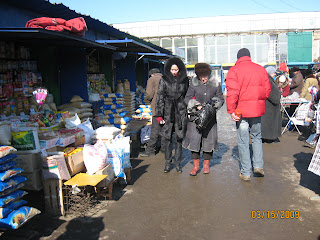
Finally, we arrive in Schichinsk, a bustling, but very poor town, criscrossed with abandoned train tracks and inhabited by a large population of fluffy stray dogs. I get a kick out of watching the dogs, with their ears perked up, crossing the streets unnoticed amid clusters of smartly dressed women. They look like they are on their way to work as well. Occasionally, you see them stop and listen to snipets of conversation between men with shoulders hunched against the cold, before trotting along purposefully. I asked Makhabbat why there are so many dogs, but no cats. She answered with a short laugh that it is too cold for cats.
The stylish dress of the Kazakh people belies the conditions in which many here live. Every morning we will see at least one young man or elderly woman slowly pulling a sled carrying a single large metal jug filled with water from the large communal pipes in the middle of town. Fences and roofs are made from sheets of corragated iron. Plaster crumbles off the white dakas with the pretty blue shutters.
Yesterday, we caught a young couple passionately kissing on the edge of the train tracks. We all agreed that it was a good way to keep warm.
Then we arrive at the babyhouse, breeze through the entryway which smells strongly of cabbage and mashed potatoes, enter the nursery, catch sight of our baby boy and forget the world. Here are some pictures that we took of our very smiley boy today before my camera died.


That's all for now.
Paka!
Becca

 Before (our little rock and roll mohawk man)
 Sitting on Mama all bundled up with a super cute hat. (good buy Daddy!)
 Flying with Daddy. He loves it!
  Yellow Bowling Pin Bear!!!!
 Tummy time with Daddy
 Chastized by caregivers for letting him play without a hat. Apparently, he was freezing. I neglected to mention that his head would have been significantly warmer with hair.
  This caregiver, in particular, is our constant superviser. Garrett loves them all. I can't help but feel ridiculously jealous when he smiles at them as they pass.
 Back to playing. Kisses from Daddy
 Kisses from Mama
  Standing... I know. I know. He's freezing.


 Going...



 The babyhouse caregivers have pasted strips of thin cotton cloth to the seams around all the windows in an attempt to keep the heat in and the cold out. The cloth is a blue floral and was probably crib bedding before it got too worn for that purpose. It is beautiful and resourceful and sad.




 Daddy and the cutie pie looking out the window.

 I caught a glimpse of Tim's fierce paternal instinct as he muttered something low and terse about getting Garrett out of this institutionalized care. Not that we blame the caretakers for sniffles and colds. That is inevitable. All that we had heard about the caretakers loving these kiddos is true. Everyone we pass knows Garrett by name and they all bark "Eh! Eh! Rrruslan!" at him in friendly russian voices and wide gold toothed smiles. They are doing everything that they can for the babies in their care and we appreicate all of their efforts to keep their little ones safe and warm and happy. They really do a great job. It's just hard to see your little one wheezing and sniffling when you know that you are ready and able to do better.

 Then, as we were permitted to let him play on the floor in this room, we let him have some tummy time.
 After a while, our pumpkin was tired again and we just held him and rocked for the rest of our time together.

 A view out the window of the older children's play area
 A wooden wall hanging with a mother hen gathering in her chicks.
 Acoustic ceiling tiles with butterflies printed on them
 The front of the music room, with piano, a stack of xylophones on the shelve and a radio. There was also an accordian which we heard them playing for the children yesterday when we came in. Each of the groups of older children (up to age 3) have music time everyday in this room.
